
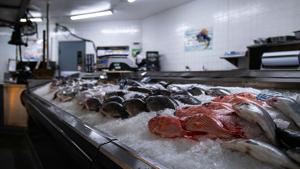
Sullivan, Peltola spar over fishing in Senate debate
Sen. Dan Sullivan, R-Alaska, and Mary Peltola sharply disagreed on policies related to Alaska fisheries over the weekend, in the first debate between the two candidates running for Alaska’s hotly contested Senate seat.
Alaska shipped more than $2.5 billion in domestic seafood exports abroad in 2025, according to the U.S. Trade Representative’s Office. However, Sullivan and Peltola both said the industry has struggled in recent years for different reasons.
Sullivan said competition from Russia and China has stifled Alaska’s fishing industry and weakened competition. He touted his work to ban Russian seafood imports in the U.S. and efforts to block Chinese imports.
The incumbent senator also touted his work to establish the U.S. Department of Agriculture’s Office of Seafood in April, a federal entity responsible for funding and infrastructure of U.S. producers and supply chains. He also claimed responsibility for $600 million in trade relief for Alaska fishermen and $100 million for the National Oceanic and Atmospheric Administration’s ocean acidification program.
Sullivan, who is running for a third U.S. Senate term, slammed Peltola for not getting legislation passed during her slightly more than two-year stint in Congress.
“Our fishermen deserve relentless focus and action, not just talk,” Sullivan said. “In two terms in Congress, she did not have one bill signed into law, I had 63 signed into law in two terms.”
Peltola acknowledged she was in the minority during her stint in Congress due to Republicans having greater numbers in the legislative chamber.
Peltola blamed the cuts to federal programs in the Trump administration for the fishing industry’s loss of revenue. She blamed the U.S. military conflict in Iran for high gas prices that make it more expensive to operate commercial fishing ships.
“Dan Sullivan has voted for this war in Iran over 10 times,” Peltola said in reference to Sullivan’s rejection of the War Powers Resolutions to curb President Donald Trump’s military authority in Iran. “We should not be going to Washington, D.C., to fight for one party or another, we should be fighting for our fishermen.”
Peltola also slammed the Trump administration’s cuts to federal agencies through the U.S. Department of Government Efficiency. Alaska lost 1,607 federal jobs in 2025 due to cuts from the Trump administration, amounting to nearly $36.5 million lost in annual revenue, analysts said.
She called on Congress to appropriate funds for NOAA and return to a regular government funding schedule. Pelota warned that funding NOAA is essential for fishermen in Alaska to obtain accurate weather forecasts and analysis.
“These are our federal allies,” Peltola said. “We are flying blind without the surveys and research that NOAA does. We need to enshrine that agency and make sure that they have recurring funds.”
Peltola also slammed Sullivan’s work to establish the USDA Seafood Office. She said the agency focuses more on farming fish than catching them in the wild.
Sullivan defended the seafood office during the debate. He said the office has brought together seafood farmers to push for loans and insurance policies in support of their businesses.
“They’ve been outside the USDA, they’re now inside the door, the door is open,” Sullivan said. “It is a tremendous opportunity, it’s something I’ve worked on through three different successive administrations and we got it done.”
Sullivan touted his work to ban seafood harvested in Russia from being sold in the U.S., part of an effort to support Alaskan fishermen. He touted continued work to fight against Chinese fishermen and “unsustainable environmental practices.”
The incumbent senator said high gas and diesel prices from the conflict with Iran could be solved by investing more resources into Alaskan energy. He pointed to Peltola’s alignment with the Biden administration, preventing future oil and gas pipelines from being built in the state.
“My opponent would ally herself with the anti-Alaska energy groups in Congress who will do what they always do, shut down Alaska energy, and that would be really horrible for all Alaskans, including our fishermen,” Sullivan said.
The debate comes as Alaska voters enter the final stretch of the midterm election cycle. The Cook Political Report ranks Alaska’s U.S. Senate race among six “toss up” elections throughout the country, which means either candidate has a chance of winning the race.
Absentee ballots for military and overseas voters will begin to be sent out on Sept. 19. Early in-person voting goes from Oct. 24 to Nov. 1. Polls are open on Election Day in Alaska from 7 a.m. to 8 p.m.


Mostly Clear
