
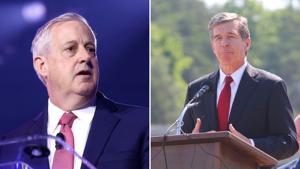
Election 2026: Cooper forecasts race decided by 3% or less
Democrat Roy Cooper, U.S. Senate candidate in the national attention-grabbing North Carolina race against Republican Michael Whatley, tells a national broadcaster no matter what the polls say his race is likely to be decided by 3% or less.
Pattern history of decades says he’s an underdog; the past year of campaigning, donations and polls says he’s the favorite. Party supporters are combining advertising buys of more than $100 million before Election Day.
Absentee voting in the nation’s longest voting window (61 days) began Sept. 4 ahead of Election Day Nov. 3.
Cooper led Whatley 48%-42% in a weekend poll release from Trafalgar Group, 49%-38% in an Elon University poll released Thursday, and 46%-39% with 14% undecided in an East Carolina University poll released Thursday.
“Nothing has changed that we didn’t anticipate,” Cooper told Manu Raju of CNN while on his “Make Stuff Cost Less” campaign tour. “North Carolina hasn’t sent a Democrat in almost two decades and only two in the last almost 40 years. It’s tough for a Democrat to win a U.S. Senate seat in North Carolina. This is going to be anywhere from a 1% to 3% race. Someone asked me what my biggest concern was, and I said that people take this race for granted.”
Planned advertising spending from Sept. 8 through Election Day is $100.6 million, with $51.8 million from Republicans, $48.8 million on the Democrats’ side. Cooper lamented what he calls negative attack ads from Whatley since July; the Republican candidate can claim the same.
Voters are being hammered, and registrations have been running away from both parties. Since Election Day 2024, net total registrations are up just 6,445 and the unaffiliated bloc has gained nearly times that at 186,411 courtesy in part to Democrats losing 132,142 and Republicans losing 18,142.
Whatley, asked about any breaks from the Trump administration policies, remains steadfast in loyalty. The former chairman of the Republican National Committee switches a question on Iran, tariffs and inflation higher than when Trump arrived in office (3.0% January 2025, 3.4% today down from 4.2% in May) to point out how much lower it is than when President Joe Biden was in office (1.4% January 2021 when inaugurated, 9.1% June 2022, 2.9% December 2024 final month).
“When we talk about the war on Iran,” Whatley said, “we need to ensure that Iran does not have a capacity to build or deploy nuclear weapons. The president took decisive action and we’re moving forward with that.”
Tuesday represents the 200th day since Israel and America launched strikes on Iran. There’s arguably nominal, if any, end in sight today compared to any point in the last nearly seven months.
“We need trade policies that are going to help North Carolina farmers, manufacturers and small businesses,” Whatley said when asked if he is 100% behind tariff policies from the president.
Asked about his release of 3,500 prisoners in a litigation settlement where he’s a defendant, Cooper again said “the court ordered” the settlement. He earlier, in July, said prison officials made decisions on who got out, his administration’s brush with transparency had no searchable database and said criteria for release was those who may be pregnant, already on home leave with a 2021 projected release date, already on work release with a 2021 release date, or have a 2021 projected release date.
Specifically, it said for inmates to be considered, “offenders must NOT be serving a sentence for a crime against a person.”
In fact, dozens did have such sentences. Eighteen, at least, have been documented to have racked up one or more murder charges since release; and state Sen. Phil Berger, R-Rockingham, earlier this year helped facilitate the ability of journalists to find names and even set up the database the administration didn’t provide.
Cooper says Whatley’s campaign is lying about connecting him to the cases.
The Trafalgar poll sampled 1,084 likely voters Tuesday, Wednesday and Thursday of last week and brings a +/- 2.9% margin of error.
In the ECU Poll from its Center for Survey Research, sampling was Aug. 31-Sept. 3 of 675 registered likely voters. The poll has a +/- 4.4% credibility interval. In a forced choice, meaning no undecided option, Cooper led Whatley 52%-44%.
Also from the ECU Poll, each candidate collects about 1% from the opposite party, and 17% are undecided among self-described independents while Cooper takes the rest 45%-34%.
Cooper’s bid to succeed Republican Sen. Thom Tillis would be trend-breaking if successful. Tillis, Richard Burr and Ted Budd have made Republicans 5-for-5 since Democrat Kay Hagan won election to the U.S. Senate in 2008.
Republicans in statewide races for this decade – 2020, 2022 and 2024 – are 32-10 against Democrats, a party with significantly declining voter registrations for more than 20 consecutive years.
This U.S. Senate seat is viewed as a major player nationally in the quest for a majority in the chamber. Republicans have 53 seats today. In no particular order, Ohio, Michigan, Georgia, Maine, Iowa, New Hampshire, Alaska, Texas and Montana are the other top battlegrounds among 35 races. Two of those are special elections, the other 33 are in regular rotation.




Sunny
