
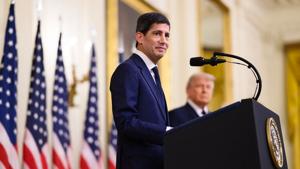
Fed hikes rates as federal net interest tops $1 trillion
The Federal Reserve raised interest rates a quarter point Wednesday, its first increase in three years, a unanimous move that came despite President Donald Trump’s demands for cuts, with officials signaling more increases could follow this year.
The increase keeps short-term borrowing costs elevated heading into fall for credit cards and auto loans, and can put upward pressure on mortgage rates through its effect on longer-term Treasury yields. It also holds up one of the government’s fastest-growing expenses: interest on the nation’s debt.
The Fed vote was unanimous, 12-0, a shift from July, when three officials dissented in favor of the same quarter-point increase and were outvoted 9-3. This time, the entire committee, Chairman Kevin Warsh included, backed the hike.
The Fed also dropped its earlier language attributing inflation to energy and supply shocks, saying only that inflation “remains elevated” and that the move would support a “timelier return” to its 2% target.
“The plain fact is that inflation is too high, and has been for too long,” Warsh said at a news conference, calling the unanimous vote a sign of the Fed’s resolve to restore price stability faster.
Warsh pointed to three developments since July: an economy that had strengthened, inflation trends that in his view still weren’t improving, and shifting geopolitics.
“This summer’s inflation readings do not tell me that underlying trends have meaningfully improved,” he said.
For taxpayers, the stakes run through the federal budget. Net interest outlays reached $1.017 trillion in the first 11 months of fiscal 2026, up about 9% from the same period a year earlier, according to the Treasury Department. That now exceeds what the government spends on national defense, and works out to about $6,247 for every individual income tax return the IRS processed in fiscal 2025.
Kent Smetters, faculty director of the Penn Wharton Budget Model, told The Center Square the decision’s cost to the debt would be “trivial.” The nominal interest rate the Treasury pays is not what matters, he said, because the tax base grows with inflation too.
“Looking at nominal interest costs without looking at the nominal growth in the tax base is just a very common mistake that people are making.” Smetters said the more relevant measure is the government’s real, inflation-adjusted borrowing cost, and if the hike restores the Fed’s inflation credibility, it “could reduce the government’s real borrowing costs later.”
Orphe Divounguy, chief economist of the Quantitative Research Group and a former Zillow economist, had argued the Fed should hold, seeing elevated inflation as an energy shock that higher rates can’t fix.
He warned the hike lands hardest on households already stretched. Long-term Treasury yields rose after the decision, and because mortgage rates move with those yields, the housing market stays frozen, in his view, while lower-income and younger borrowers keep paying elevated rates on cars and credit cards. Hiring, he noted, has narrowed to essentially one sector, health care.
“The Fed is insuring against a broadening that isn’t showing up in inflation expectations,” he told The Center Square, and “paying for it with a slowdown in the parts of the economy that are already weakest.”
The unanimous hike came despite Trump’s repeated demands that the Fed cut rates and warnings of consequences if it didn’t. Hours after the decision, Trump repeated the demand on Truth Social, writing that U.S. interest rates “should be 1%, or less” and calling on the Fed to “LOWER THE INTEREST RATES FOR THE UNITED STATES OF AMERICA, AND FAST!”
Warsh, whom Trump elevated to the chairmanship amid his push for lower rates, declined to engage.
“I’ve got nothing for you on a discussion with the president,” he told reporters on Wednesday, adding that Fed independence “is a two-way street.”
Most officials expect they aren’t done. In projections released with the decision, 16 of 18 officials projected the federal funds rate above its current midpoint at the end of the year.
Warsh declined to commit, saying he is “not in the forward guidance business.” Whether the Fed is right to lean against a supply-driven inflation, Divounguy said, will take months to judge. “Reasonable people differ,” he said, “and the data over the next few months will tell us who read it right.”




Mostly Sunny
