
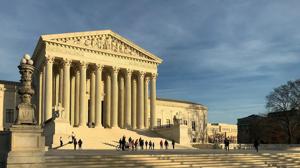
Lawmakers scold, praise U.S. Supreme Court ahead of term
(The Center Square) – Lawmakers both expressed frustration and praised the U.S. Supreme Court on Wednesday before its term begins on Oct. 5.
U.S. Sen. Dick Durbin, D-Ill., Rep. Darrell Issa, R-Calif., and other legal analysts criticized and praised various aspects of the nation’s highest court ahead of the 2026 term. Durbin slammed President Donald Trump for criticizing justices on the nations highest court in a recent social media post.
Durbin said the high court’s independence has been under threat since Trump returned to the White House.
“This has become so political and a lot of it has to do with the president who will go in the middle of the night and rail against the Supreme Court for their rulings,” Durbin said. “This is unheard of in previous administrations.”
Durbin lamented the Senate’s changing process for approving federal judges and Supreme Court justices. He said Senate Republicans choosing to wait until after the 2016 election to fill a vacancy on the nation’s highest court altered the court’s makeup dramatically.
“I wish we could go back to the old days where you literally took 60 votes for the Supreme Court because I think we would have a much different category of justices than we have today,” Durbin said.
Issa also lamented the Senate’s decision to hold off on the vote and said it violated the U.S. Constitution.
“The Senate should have to make an up or down vote on nominees within a period of time, whether they’re judges or cabinet officers or under secretaries, and anything else is thwarting the clear, reasonable intent of the Constitution,” Issa said.
Issa and Durbin appeared to divide on whether the nation’s highest court should add justices to the high court. Democratic lawmakers have recently proposed expanding the high court to more than nine justices, prompting Republicans to advance a constitutional amendment to cap the court at nine.
“I don’t think we should change it,” Issa said. “But I also don’t see any reason to change the constitution.”
Durbin did not answer the question about expanding the high court directly but said it was not a realistic proposal. He pointed to the possibility of a presidential veto overriding legislation to expand the high court but expressed optimism that it could change.
“I don’t think this is a realistic conversation in the current political makeup of Washington, that may change,” Durbin said.
Durbin and Issa also disagreed on the role of the high court’s emergency docket. Durbin slammed the emergency docket and the court’s lack of explanation in decision making. He said some cases are too important to go without explanation.
“I think if we’re going to have any kind of body of precedent to be followed and any kind of laws to be respected, they can’t hide it,” Durbin said. “God knows what really lies behind some of these decisions. I think it’s a serious problem.”
Issa said it is appropriate for the nation’s highest court to answer pressing legal questions quickly. He also called for the end to nationwide injunctions by federal judges across the country.
“Would I like to see less going to the court and better decisions more reputable? Absolutely,” Issa said. “I’d also like to see a true end to inappropriate nationwide injunctions done by one rogue judge.”
Legal analysts at the summit also previewed the upcoming term at the high court. Sarah Isgur, editor at SCOTUSBlog, said Suncor v. Boulder is one of the most important cases of the upcoming term.
Amy Howe, founder of SCOTUSBlog, agreed. The case focuses on whether state and local governments can regulate fossil fuel companies for alleged contributions to climate change and could cost energy companies as much as $28 trillion depending how the case is decided.
“There are billions and billions of dollars at stake here because right now there are over two dozen similar lawsuits going on,” Howe said. “It could affect opioid litigation, it could affect local data centers, you could have all kinds of ramifications.”
David French, a columnist for the New York Times, said the most important case is Viramontes v. Cook County and Grant v. Higgins, consolidated cases challenging Illinois and Connecticut bans on semi-automatic weapons.
French said the case is the most recent notch in the dispute over Bruen v. New York Rifle and Pistol Association, a case that set the precedent that history and tradition explanations are necessary to justify restricting Second Amendment rights.
“The legal issue though in the approach to text, history and tradition, it’s in the Second Amendment context where this is being worked out more than anywhere else,” French said.






Mostly Sunny
