
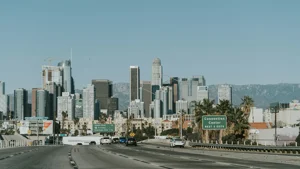
Economists say Los Angeles needs more money for Olympics
Organizers of the 2028 Olympics in Los Angeles aren’t getting enough money from the state or federal government, which could mean traffic congestion and snarls disrupting the city’s life and commerce, according to economists who study the Games.
Andrew Zimbalist, a professor emeritus of economics at Smith College in Northampton, Mass., told The Center Square on Sunday that the LA28 Olympic Organizing Committee needs at least $2 billion for transportation costs alone.
“If they don’t get the money from the federal government, and they’re not going to get money from the city of Los Angeles, and it doesn’t seem that money from the state is going to be forthcoming in an appreciable amount, then they’re going to be in big trouble,” said Zimbalist, who has written extensively about the economics of sports and the Olympics. “It’s going to be a mess. So this is a crucial crossroads that they have to pass through, and I think it’s going to have a large bearing on the outcome.”
In the event of a budget shortfall, Zimbalist added, the cost could potentially be borne by Los Angelenos.
The International Olympic Committee would require $275 million to be covered by the city of Los Angeles and another $275 million would have to be covered by the state, he said.
“If there’s still a deficit after those two contributions, then it all falls on the city of Los Angeles,” Zimbalist said. “So yes, it’s certainly a risk.”
The Los Angeles Times previously reported that the city requested $379 million just for transportation projects alone to handle the influx of tourists and traffic the city expects for the Olympics in 2028. The Legislature only allocated roughly $20 million for the transit costs, according to the Times.
Los Angeles County Metropolitan Transportation Authority, commonly known as L.A. Metro, also asked the federal government for $2 billion to pay for needed transportation projects in preparation for the Olympics, according to news reports.
The Center Square reached out to the White House for comment for this story and did not hear back before publication time on Monday.
Victor Matheson, an economist at the College of the Holy Cross in Worcester, Mass., told The Center Square on Monday that the Legislature might not have funneled as much money to Los Angeles as officials requested because the city already had substantially built-out infrastructure to accommodate the Olympics.
“They may be saying, ‘Look, there’s obviously short-run increases in bus and subway schedules and things like that that may be necessary, but certainly in the way of construction, the whole point of choosing L.A. is you don’t need a bunch of construction to happen to make the Olympics go,’ ” Matheson, who studies the economics of the Olympics, told The Center Square on Monday. “The whole reason L.A. is chosen is because of its existing transportation and sports infrastructure.”
Matheson also said that California legislators might not see that much of a payout for the state as a whole.
“This may result in an inflow of additional tourists to L.A. or the L.A. metro area, but it’s not clear why the state benefits from that in any appreciable way,” Matheson said.
The state budget, which Gov. Gavin Newsom signed into law after the Legislature passed it, included $96.5 million of state funds to pay for maintenance projects necessary to accommodate the increased patronage for the Olympics. Of that money, $76 million will come from the state’s general fund, and $20.5 million will come from the Exposition Park Improvement Fund. The park is the location of the Los Angeles Memorial Coliseum, which will be used for track and field events during the Olympics. The same venue was used for the 1932 and 1984 Olympics.
According to an August 2025 report prepared by city officials, the 2028 Olympic and Paralympic Games budget went up from $6.884 billion to $7.149 billion, a reflection of market conditions, a larger sports program, inclusion of a preferred venue master plan and a change in contract negotiations. The International Olympic Committee foots part of the bill to carry out the Olympics and allocated roughly $1.8 billion to Los Angeles. The Committee gave Paris the equivalent of $1.7 billion for the 2024 Olympics, according to numbers from the International Olympic Committee website.
That report also shows that organizers expect the cost of the 2028 Olympics to be fully paid for after counting receipts from the International Olympic Committee, ticket sales, domestic sponsorships and licensing.
Los Angeles Mayor Karen Bass has said she planned for the 2028 Olympics to be “car-free” games, according to news reports, and that transportation was a key issue in the city’s preparations.
“Mayor Bass will continue to advocate for the critical funding that Los Angeles needs to deliver a successful Games and the infrastructure that will benefit Angelenos for decades,” Bass’s office wrote to The Center Square via email.
Bass’s office did not make Bass or other city officials available to answer questions for this story. The president of the Los Angeles City Council, Marqueece Harris-Dawson, as well as officials from Los Angeles County, did not respond to The Center Square.
“The promise of a ‘car-free’ Olympics was never realistic for Southern California,” Assemblymember David Tangipa, R-Fresno, told The Center Square on Monday. “The focus now should be on making lasting improvements to ensure Californians can actually get to and from work and pick up their kids. Los Angeles developed its computerized traffic-control system for the 1984 Games, and more than 40 years later it is still helping move people across the city. We should use 2028 the same way: Solve real transportation problems and leave Southern California with something useful when the Games are over.”
While the Legislature only allocated $20 million for transportation projects in Los Angeles, far short of the $379 million city officials asked for, Sen. Roger Niello, R-Fair Oaks and vice chair of the Senate Budget and Fiscal Review Committee, said he wouldn’t necessarily call the $359 million difference a cost-savings.
“A savings is money that was not spent that otherwise would be committed,” Niello told The Center Square on Monday.. “This is very much discretionary money. So I don’t know that I’d call it savings, but I’m not sure we’re at the end of whatever state and federal assistance might be provided to L.A., so we’ll see what happens as time goes on.”
The Center Square reached out to multiple Democratic state lawmakers for this story, who either did not respond before publication time on Monday or declined interviews. The International Olympic Committee also did not respond to The Center Square.



Partly Cloudy
