
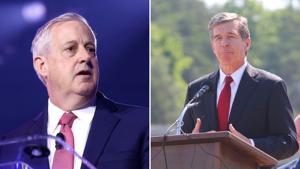
Election 2026: Three hurricanes, two candidates, and a quest for votes
Hurricanes 10, eight and two years ago and subsequent recovery efforts are being pulled into North Carolina’s U.S. Senate election campaigning involving Democrat Roy Cooper and Republican Michael Whatley.
The former was in the governor’s office essentially for all three, the latter was chosen by the president to help Hurricane Helene recovery more than six months before he opted into this pivotal Senate race for majority in the chamber. Each candidate says the other has failed when it comes to hurricane recovery, using different methods to illustrate.
Somewhere between the truths, campaign rhetoric and exaggerations, there is reality.
This U.S. Senate seat is viewed as a major player nationally in the quest for a majority in the chamber. Republicans have 53 seats today. In no particular order, Ohio, Michigan, Georgia, Maine, Iowa, New Hampshire, Alaska, Texas and Montana are the other top battlegrounds among 35 races. Two of those are special elections, the other 33 are in regular rotation.
Cooper was on the campaign trail prior to becoming governor when Hurricane Matthew landed near McClellanville, S.C., on Oct. 8, 2016, and continued into North Carolina. Two years later on Sept. 14, 2018, Hurricane Florence came ashore at Wrightsville Beach and delivered another devastating blow to the southeastern part of the state.
About three months before Cooper exited his second term, Hurricane Helene came ashore at Dekle Beach, Fla., on Sept. 26, 2024, and continued to the Carolinas and Tennessee mountains. At the time, Whatley was chairman of the Republican National Committee as the hand-picked leader by Donald Trump on his way back into the White House for a second term.
Recovery from Matthew and Florence was well within Cooper’s purview. He created the Office of Recovery and Resiliency to help the southeastern North Carolinians recover and rebuild, only to eventually try and slip in a $175 million request for its budget shortfall with a larger package of relief under the immediate Helene recovery funding.
Arguably, Cooper’s initiative was a third disaster.
“You have proven that you don’t have the capability of being trusted with the taxpayers’ money,” Rep. Brenden Jones, R-Columbus, who chaired a November 2024 oversight meeting, said to Chief Operating Officer Laura Hogshead of the department created after Florence. “No one has any more sympathy or empathy for the people of this state that are affected by the storms than I do. I have to live with them every day … you don’t. You say you care, but you certainly haven’t shown it.”
Of the 4,200 families approved for new homes in North Carolina, Hogshead reported that only 2,800 of those have been completed eight years later. The office also owed approximately $37 million for projects already completed. As Cooper left office Dec. 31, 2024, more than 1,100 families were still in temporary housing waiting for the government.
The budget shortfall wasn’t known publicly until Cooper included the $175 million request in a $3.9 billion relief package for the General Assembly to approve helping Helene victims. Lawmakers, a Republican majority in Raleigh, went a different route to help.
And Whatley, not even in office, found a path, too.
Bill Lapsley, a commissioner in Henderson County at the time, said Whatley lined up millions of dollars. Within five days in fact, about $15 million through the Department of Homeland Security.
“They lost hundreds of millions of dollars, and people were still living in hotels six and eight years after these events,” state Rep. Jake Johnson, R-Polk, told the Washington Reporter. He’s a chairman of the Oversight Committee. “Who knows what would have happened if we had not really started digging into this and people reaching out to us and saying it’s been six and eight years, and there are still hundreds of families living in hotels.”
Inauguration for Trump was Jan. 20, 2025, a Monday, and by Friday he was finally out of Washington for the first time in his second term. First stop was western North Carolina, where he placed Whatley in a pivotal position to continue helping in the aftermath of Helene.
The Republican’s campaign said he’s had a hand with Sen. Ted Budd, R-N.C., and Rep. Tim Moore, R-N.C., to name a couple in helping bring more than $11 billion to the state. Other accounting – from first-term Democratic Gov. Josh Stein’s administration and first-term Republican state Auditor Dave Boliek – put the federal total between $9 billion and $10 billion.
Told a different way while in Gastonia last week, Trump said it was the telephone call he received from Whatley that got him to North Carolina in November 2024 to see storm damage.
“It was Michael Whatley that got me to move,” he said.
Each candidate acknowledges there is more money needed, that only a fraction of the requests has been delivered.
And each says he’s the best choice to help bring it home as a member of the United States Senate.


Sunny
