
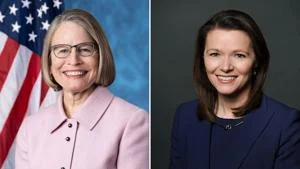
Miller-Meeks, Bohannan spar over taxes, tariffs in heated debate
Candidates in Iowa’s first congressional district race sparred over tax policies, rising energy prices and agricultural policies during a Tuesday night debate.
Republican U.S. Rep. Mariannette Miller-Meeks faced off against Democratic candidate Christina Bohannan in a debate hosted by local news channel KWQC on the campus of St. Ambrose University. The two candidates disagreed over tax policies throughout the night.
Bohannan criticized Miller-Meeks for voting to pass the President Donald Trump-endorsed “One Big Beautiful Bill” in July 2025. She said the legislation advanced permanent tax cuts for the wealthy while providing temporary relief through no tax on tips and no tax on overtime programs. Both programs are set to expire on Dec. 31, 2028.
“Her vote caused Americans to go into debt, to pay interest on this debt for years in order to give the biggest tax break to billionaires in American history,” Bohannan said.
Miller-Meeks defended her vote, citing the expansion of the child tax credit and Social Security tax deductions that are not set to expire in 2028.
“That’s real money in people’s pockets, allowing them to keep more of the money they earn,” Miller-Meeks said.
She criticized Bohannan’s voting record in the Iowa House of Representatives. In 2022, Bohannan voted against HF 2317, legislation that reduced individual income taxes to 3.9%, with an exemption on retirement-based income.
Bohannan said she voted against the bill because of the exemption on retirement-based income. She called to reduce taxes on income earned in retirement.
“That bill gave more relief to the top 1% than it did to 60% of all Americans combined,” Bohannan said.
Miller-Meeks also touted the healthcare initiatives included in the One Big Beautiful Bill’s Rural Transformation Fund. The fund appropriated $50 billion to expand healthcare across the country, with $209 million going toward hospitals in Iowa.
“Other states aren’t as good as Iowa, as we are the first state to be able to get our application through and also do our grants,” Miller-Meeks said.
Bohannan criticized the legislation as a “drop in the bucket” compared to cuts made due to Medicaid eligibility requirements introduced by the legislation. The work eligibility requirements are set to take effect in January 2027.
“It is unconscionable that Representative Miller Meeks and this Congress voted to cut Medicaid in the way that it did, and it’s going to be devastating for our rural healthcare system,” Bohannan said.
The two candidates also sharply disagreed over the agricultural issues related to the U.S. military conflict in Iran and the Trump administration’s tariff policies. Miller-Meeks defended the policies as a way to advance competition for farmers in the United States and touted construction of a $15 billion steel mill in Iowa as downstream from increased tariff revenue.
“The very tariffs she’s talking about are bringing a steel mill into Lee County with 1,700 permanent jobs at $49 an hour,” Miller-Meeks said. “You’re against tariffs, but tariffs are bringing jobs here to Iowa, and they’re helping our manufacturers here to expand.”
Bohannan said tariff policies have driven up prices for farmers across Iowa and damaged previous trade relationships with foreign countries. She pointed to a soybean trade agreement between Iowa farmers and Chinese farmers that does not exist under current tariff policies.
“Republican Governor Terry Branstad worked for years to develop that trade relationship with China to allow our farmers to sell soybeans there, and then these tariffs that Representative Miller-Meeks voted eight times to support took away that market like that.” Bohannan said.
A September trade deal between the United States and China cut tariffs on $60 billion worth of goods but omitted soybeans and other grains. Economists raised concerns about a remaining 10% tariff on American soybeans making the good less competitive in the global marketplace.
Proposals over reducing the price of gas and diesel were also exchanged between the two candidates. Miller-Meeks said she would support a federal fuel tax suspension as the U.S. military conflict in Iran continues.
“We’ve got more to do, but we haven’t worked fast enough to overturn the disastrous policies and the high inflation of the last administration,” Miller-Meeks said of former President Joe Biden.
Bohannan criticized Miller-Meeks for blaming the Biden administration on rising costs. Inflation topped 9% in June 2022, the highest rate in 40 years. Bohannan also criticized Miller-Meeks for voting eight times against a war powers resolution to reign in the president’s military authority in Iran.
The incumbent congresswoman defended her vote as a measure to allow the president flexibility. She cited her vote in favor of the resolution once a ceasefire fell through between the two countries in August.
“When the ceasefire collapsed, the Iranian regime had decapitated, and their nuclear program was severely hampered, I voted to end the Iran war,” Miller-Meeks said. “The president needs to bring the plan to us, and we need to bring diesel prices and gas prices down.”
Bohannan called for an end to the conflict in Iran but stopped short of agreeing to withdraw military appropriations if it was not over in one year.
“I’ll cross that bridge when I get there,” Bohannan said. “I have to see the state of things and see what’s going on. I would never put our military in harm’s way or anything, but you know it really does need to come to an end.”
Early voting in Iowa goes from Oct. 14 to to Nov. 1. Polls are open in Iowa from 7 a.m. to 8 p.m. on Election Day. For more information, visit the Iowa Secretary of State at sos.iowa.gov.
For results on Election Day, visit thecentersquare.com/iowa.






Sunny
