
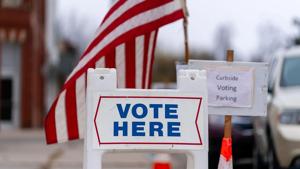
Coloradans to vote on ban on gender-changing surgeries
Colorado voters will decide in less than two weeks whether to ban surgeries that change the genders of minors.
If Proposition 135 passes on Nov. 3, doctors across the state will be prohibited from performing procedures to alter minors’ sex characteristics.
Prop. 135’s description says a “Yes” vote would prohibit surgeries on minors that would “alter their biological sex characteristics as a treatment in response to a minor’s perception of sex or gender, and prohibits the use of government funds or health insurance to pay for the surgeries.”
The bluebook ballot guide provided by the Colorado General Assembly reported that the state’s three large pediatric surgical providers – Children’s Hospital Colorado, Rocky Mountain Children’s and Denver Health – say they’re not performing gender- or sex-based surgeries on transgender patients under 18.
“The side effects of sex-rejecting surgeries are real and lasting, with some that can result in loss of fertility,” said Dr. Kurt Miceli, chief medical officer at Do No Harm, a medical advocacy nonprofit opposed to the procedures.
“It would be irresponsible for a doctor to perform such a drastic, irreversible operation on an adolescent, whose capacity for long-term judgment is still developing,” Miceli told The Center Square in an email.
Polling shows the vote on Prop. 135 could be close. Of those surveyed, 52.1% said they would vote for it, according to On Point Politics on its website. To pass, the measure needs a simple majority of more than 50% of votes. El Paso County, which is the state’s most populous county, is expected to vote for the measure by a greater margin: 60.7%.
Although Prop. 135 only affects Colorado, a new federal ruling from the Department of Health and Human Services would prohibit all 50 states from using federal Medicaid funds for certain sex-changing surgeries on minors. That rule went into effect on Oct. 13.
This federal ruling also would prevent other federal funds, such as Child Health Plan Plus, from being used for gender-related medical care, according to Marc Williams, the public information Officer for the Colorado Department of Health Care and Policy Financing.
He told The Center Square that Colorado could consider using state funds to administer these services, but that money would have to be allocated by the Legislature.
According to August 2026 data from the healthcare department, the state serves nearly 450,000 children on Medicaid. There are also around 70,000 people, including pregnant women, enrolled in the Child Health Plan Plus program.
The state also reported approximately $1.13 billion in Medicaid medical premiums expenditures in July 2026, although the report does not specify how much was spent on gender-related healthcare services.
Do No Harm documented 60 cases across Colorado since 2023 in which gender-altering procedures took place.
The medical advocacy organization said Children’s Hospital of Colorado performed 13 sex-altering procedures on minors.
Do No Harm said Denver Health performed these surgeries on six minors, but Denver Health is questioning Do No Harm’s data.
Do No Harm obtained its data from an all-payer medical claims database that combines information from several sources, including commercial health insurance companies, Medicare and Medicaid, Veterans Affairs claims and other sources.
The particular methodology comes from the data gathering process provided to The Center Square by Do No Harm spokesperson John Woude.
Do No Harm then used two types of medical billing codes to identify potential gender-transition surgeries. The organization also reviewed Current Procedural Terminology codes, which identify the medical procedure being billed, such as a mastectomy, breast augmentation, hysterectomy or genital reconstruction.
For puberty blockers, Do No Harm used national codes that identify prescription medicines. Medications such as testosterone, estradiol and leuprolide (Lupron) were included in the nonprofit’s search. These medications are not exclusively used for gender transitions, but most generally are, according to Do No Harm’s analysis.
Colorado’s voter guide did not explicitly say whether hormone therapy is prohibited in Prop. 135, but noted that the measure doesn’t restrict non-surgical gender-related treatments, such as social transitioning or counseling.
The Center Square reached out to Denver Health Center, which has a specialized LGBTQ+ treatment center but stopped gender-changing surgeries.
“After careful review of the many escalating actions of the U.S. Department of Health and Human Services (HHS) to restrict health care institutions and individuals from providing gender affirming care to youth under the age of 18, Denver Health has made the difficult decision to suspend gender affirming care to youth, including puberty blocking prescriptions and hormone therapy,” said Dedra Bingas, a spokesperson for Denver Health.
“Surgeries were stopped early in 2025,” Bingas told The Center Square in an email.
“Denver Health did not participate in the Do No Harm data collection,” Bingas added. “Upon initial review, we question the findings and don’t believe they accurately reflect our practices.”
Denver Health referred The Center Square to its website refuting Do No Harm’s data.
The website says Do No Harm incorrectly classified medical procedures as gender-transition-related. Specifically, Denver Health said it found an issue with the organization comparing CPT procedure codes alongside gender-related diagnosis codes. Some of the codes indicated a minor received medical procedures such as hair-removal by electrolysis, which can be performed for cosmetic or other reasons unrelated to gender transition, Denver Health noted.






Sunny
