
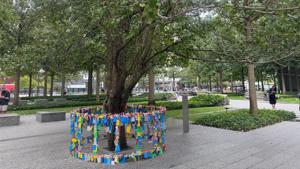
Resilience and hope remembered this Thanksgiving at 9/11 Survivor Tree
Twenty-five years after the worst terrorist attack on U.S. soil, a tree stands tall pointing to resilience and hope. It’s a place where people come to find rest and give thanks.
On the morning of Sept. 11, 2001, the sky was a clear cornflower blue. After Islamic terrorists hijacked two commercial planes and flew them into the World Trade Center, the twin towers later collapsed. The sky turned black. The air was full of ash and dust, which covered the area, buildings, streets, survivors and rescue workers.
All seven buildings at the WTC complex were destroyed and an area the size of roughly 12 football fields was turned to a smoldering pile of ash. What became known as Ground Zero and “the pit” or “the pile” burned for more than 100 days.
It was into this smoldering pit of fire, ash and smoke that first responders rushed to rescue as many people as they could.
At Ground Zero, 2,700 vertical feet of structural materials were transformed into a pile of twisted steel, concrete rubble, tangled rebar and unidentifiable gray matter. The wreckage burned at temperatures reaching 2000 degrees Fahrenheit. The air smelled like burning metal as toxic fumes filled the air. Eighteen people were pulled out alive. The last was 30-year-old Genelle Guzman who had been buried for more than 26 hours.
Thousands of construction and iron workers began removing the debris and law enforcement personnel searched for criminal evidence, personal effects and human remains. Within three days, working around the clock, rescue workers transported roughly 1,500 truckloads of 9,000 tons of material to Fresh Kills, a former landfill in Staten Island that is now a park. Eventually, 1.5 million tons of debris would be transported there.
About a month into the cleanup, workers found a Callery pear tree buried under the rubble. Its top had been “decapitated,” Richie Carbo, who was with the New York City Parks Department, said in a video produced by the memorial.
The pear tree was originally planted in the 1970s near buildings Four and Five at the WTC complex. When workers found it, its bark had been charred from the fire and most of its limbs reduced to stumps. But part of it was alive and reached 8-feet tall.
“It had one branch still alive, poking out of the debris,” with green leaves, Ronaldo Vega explained in a separate video produced by the memorial. He was a former NYC Department of Design and Construction Project Manager who helped with cleanup from Sept. 18, 2001, through July 12, 2002.
It was October and “trees don’t give off leaves in October,” he said. “Unless the tree is dying and wants to live. Unless the tree wants to show the world, ‘I still have life.’”
The tree was brought to a nursery and to Van Courtland Park in the Bronx where NYC Department of Parks & Recreation staff nursed it back to life. When they first got the tree, they didn’t think it would survive, Carbo said. But they diligently took care of it and in the spring of 2002, buds turned into blooms. “You could see there was life in the tree,” he said.
Out of the darker, rougher bark grew smooth branches, pointing to life after death.
The darker bark at the bottom represents “the damage from 9/11 itself and the horror of that day,” Varga said. The new growth points to “healing and recovery. This tree is still here, like we are still here. It’s striving and surviving, there’s no reason why we can’t.”
Over the years, the tree grew 30 feet. It was replanted in December 2010 back at Ground Zero, which is now the 9/11 Memorial & Museum. By the spring of 2011, it burst into magnificent blossoms, “embodying a living symbol of resilience.
“New, smooth limbs extended from the gnarled stumps, creating a visible demarcation between the tree’s past and present,” the memorial says. Now called the Survivor Tree, it is “a living reminder of resilience, survival, and rebirth.”
In the fall of 2011, Stamford, Connecticut-based Bartlett Tree Experts began harvesting seeds from the tree. In September 2013, the memorial launched a seedling distribution program in partnership with Bartlett and John Bowne High School in Queens. Students care for the seedlings through the school’s agriculture curriculum, the Memorial explains.
Over the years, Survivor Tree seedlings have been distributed to communities impacted by major tragedies across the country and the world.
In Texas, communities have received seedlings after violent acts, which have now grown into full pear trees.
In 2014, seedlings were sent to Fort Hood in Killeen, Texas, after an Islamic terrorist killed 13 and wounded 32 in 2009. He faces the death penalty by firing squad next week, The Center Square reported. In 2021, seedlings were sent to the community in Sante Fe, Texas, after a high school student killed 10 and wounded 14 in 2018.
A children’s poem and video also tells the tree’s story to share thanksgiving and hope.
When visitors come to the 9/11 Memorial & Museum, they are encouraged to leave messages and prayers at the tree. One message left on the 25th anniversary of 9/11, reads, “God bless you and keep you. The Lord shine his face on you. The Lord turn his face on you and give you peace. Numbers 6:24-26.”





Rain
