
U.S. Supreme Court to hear immigrant asylum case Monday
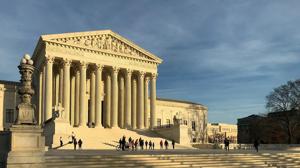
The U.S. Supreme Court will hear arguments in a case that could determine the future of immigrant asylum laws.
On Nov. 30, justices on the high court will hear arguments in Wassily v. Blanche, a case over whether noncitizens whose asylum in the United States was later terminated because of criminal convictions are eligible to become lawful permanent residents. The case focuses on Tamer Wassily and Byron Velasquez Arreaga, migrants from Egypt and Guatemala, respectively, who were convicted of crimes that led to the government moving to revoke both men’s asylum status.
The two men sought to become lawful permanent residents in the United States, citing fear of persecution in their home countries to prevent their return. An immigration judge granted Wassily’s request to become a lawful permanent resident, but the Board of Immigration Appeals said he was ineligible because of his criminal conviction.
Matthew O’Brien, deputy director of the Federation for American Immigration Reform, said immigration law allows for migrants who committed crimes to have their asylum status terminated.
“The U.S. is not under any domestic statutory obligation, or international legal obligation to accept any alien for asylum or continue to shelter any alien who has already been granted asylum,” O’Brien wrote in an email to The Center Square.
O’Brien said the case boils down to protecting American citizens and national sovereignty over the interests of immigrants who could be harmed in foreign countries.
“Actions have consequences, and if [Wassily and Velasquez] were genuinely concerned about being returned to their countries of origin, then they should have refrained from engaging in criminal behavior in the state that had granted them protection,” O’Brien said.
Lawyers for Wassily and Velasquez urged the justices to reject the lower court’s decision to terminate asylum and prevent the two from obtaining lawful permanent residence status.
“It will harm all those who, but for termination, would have been worthy of waivers for humanitarian, family-unity, or public-interest reasons,” lawyers for Wassily and Velasquez wrote in a petition to the high court.
O’Brien said only green card holders with exceptionally good civic, social and economic success in the United States who are convicted of minor violations should be allowed to remain in the country.
“Illegal aliens who have been convicted of any kind of crime should not be allowed to remain in the U.S. under any circumstances,” O’Brien wrote. “Doing so simply rewards them for serial violations of America’s laws.”
However, lawyers for the two migrants said the decision to terminate their asylum will also have ripple effects on immediate family members. When a principal applicant for asylum commits a “particularly serious crime,” the derivative status that applicant’s spouse or children can also be terminated, according to U.S. immigration law.
Wassily was convicted of third-degree stalking and child endangerment, according to a court filing. Velasquez was convicted of driving while intoxicated. Both convictions were deemed particularly serious crimes by an immigration judge.
In 2023, nearly 5,000 individuals received derivative asylum in the United States, according to court records.
“If the decision below stands, these innocent spouses and children – through no fault of their own – will be precluded from adjusting to [Lawful Permanent Resident] status and will face removal themselves,” lawyers for Wassily and Velasquez wrote.
The rule of lenity, a principal of criminal law, requires courts to interpret a statute as narrowly as possible when it is unclear about whether specific criminal activity is prohibited. However, the rule does not apply to civil cases, including immigration, the area issue before the court.
O’Brien said he expects the justices to pay attention to this aspect of the case and settle whether the rule can apply to immigration issues.
“This seems like a settled issue. The Second Circuit, which has never been accused of being conservative, definitively found that none of the arguments advanced by the petitioners in this matter had any merit,” O’Brien wrote. “I would expect that the Supreme Court’s opinion will be focused primarily on the rule of lenity and its inapplicability in the civil, immigration context”






Slight Chance Light Rain
