
Inquiry lists failures in response to Palisades, Eaton fires
Findings from a new investigation into the 2025 Palisades and Eaton fires have Angelenos shaking their heads.
The independent inquiry by the UL Research Institute — commissioned by California Gov. Gavin Newsom — revealed widespread communication breakdowns, institutional disconnections and tactical errors during the catastrophic fires.
After the investigation’s results were released, Joy Chen, co-founder of the Every Fire Survivor’s Network, expressed deep frustration.
“This is yet another report telling us about all the failures of the night,” Chen told The Center Square.
“We really wish that the government would focus more on fixing the problems rather than, you know, just issue another report on the failures,” said Chen, whose Altadena home suffered smoke damage from the Eaton Fire.
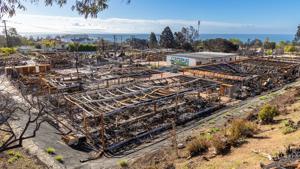
The Los Angeles County blazes started on Jan. 7, 2025. The Palisades Fire burned 23,448 acres in the coastal Los Angeles and Malibu area and resulted in 12 deaths and the destruction of 6,833 structures.
The Eaton Fire burned 14,021 acres in the Pasadena-Altadena area and led to 19 deaths and the destruction of 9,419 structures.
Paramedics and sheriff deputies witnessed severe ember storms and structures burning in West Altadena hours before widespread alerts were issued, according to the UL Research Institute. However, because the paramedics operated independently and were not integrated into the fire command structure, their vital observations never reached incident leaders, the institute reported.
Most residents in West Altadena, where 18 out of 19 Eaton Fire fatalities occurred, did not receive mandatory evacuation orders until it was too late. according to the new investigation. The fire was already sweeping through the unincorporated community.
Meanwhile, the Los Angeles County Fire Department incident command center at the Rose Bowl was disorganized and unaware that the fire had pushed westward until daylight hours, UL Research Institute determined.
Regarding the Palisades Fire, the Los Angeles (City) Fire Department initially contained a smaller fire in Topanga State Park on Jan. 1.
Despite warnings from ground personnel that the site was still smoldering as dangerous red flag weather approached, the UL Research Institute report says the department failed to properly monitor or reinspect the area. The institute also found the city fire department’s commanders initially overseeing the response lacked experience with large, complex wildfires. At the same time, the Los Angeles Police Department and the LAFD operated on separate, unintegrated tracks, realizing only late into the disaster that they were using conflicting evacuation maps, according to the institute.
The lack of confidence in the formal leadership led to 26 fire units deploying independently without command approval, the institute reported.
Conditions improved significantly only after the California Department of Forestry and Fire Protection, or Cal Fire, assumed control of incident operations on Jan. 8, 2025, the UL Research Institute said.
Los Angeles County Supervisor Kathryn Barger called the findings serious and in need of a thorough review.
“Eaton Fire survivors, especially those who lost loved ones, deserve accountability and confidence that every lesson from this tragedy will result in meaningful change,” Barger told The Center Square in an email.
“That is why I acted quickly and introduced a motion, which the Board of Supervisors approved on October 6,” said Barger, who represents the Pasadena-Altadena area on the county governance board.
Barger’s motion directed an immediate comparison of these findings with Los Angeles County’s after-action reviews to identify gaps and determine what additional actions must be taken.
“While we can’t change what happened on January 7, we have an obligation to learn from it and ensure our emergency response systems emerge stronger and ready for when the next disaster strikes,” said Barger.
Chen of Every Fire Survivor’s Network said residents had to depend on themselves for communications during the Eaton Fire. In fact, Chen told The Center Square, residents had to do some of their own firefighting.
If it had not been for the pickleball WhatsApp of the Altadena Country Club, Chen said people in the area would not have had a way to contact one another and stay informed.
“We triangulated where the fire was based on who could see it from the homes,” said Chen. “Then we called everyone that we knew in harm’s way as the fire was moving.”
Chen also credited the pickleball WhatsApp for helping what she described as the emergency volunteer fire brigade. People were typing into WhatsApp when there was a spot fire in their yard or their neighbors’ yards. Chen and others rushed to the scenes with buckets to take water out of swimming pools to put out those spot fires.
“That’s not our job. That’s our government’s job,” Chen said. “That’s why we pay taxes.”
In the 20-some months since the fires, Chen said fire victims have continued to show up and step up for one another.
What survivors need is for the government to “fix those failures,” said Chen, whose organization is reportedly the nation’s largest survivor-led disaster recovery nonprofit with 10,000-plus survivors of the Eaton and Palisades fires and their allies.
Chen’s home was smoke-damaged and filled with what she described as toxic contamination. Her family had to move nine times with two teenage girls and two cats. Chen said her insurance company, USAA, paid for testing and remediation before Chen and her family moved back home last summer. Even so, Chen said they were lucky ones.
Two-thirds of Eaton and Palisades fire survivors are still displaced, Chen said, adding that at this point, people’s retirement savings are drained. Others have maxed out credit cards, and many people’s housing funds are running out within the next few months, she said.
“One of the major problems has been insurance,” said Chen. “Seventy percent of Eaton and Palisades fire survivors with insurance are having delays and denials and underpayments impeding their recovery.”
Chen called that another government breakdown, noting that the state has a responsibility to regulate the industry.
EFSN has stepped in to fill the gap by collecting data on insurer misconduct, starting with over 500 firsthand accounts against State Farm last year. When the state failed to act, Chen said they brought the data to Barger and Los Angeles County Supervisor Lindsey Horvath, who immediately launched an investigation and lawsuit.
Now EFSN is expanding that effort with a new survey tracking how every major insurer is performing. Results and a consumer scorecard are expected in November.
When asked what advice she has for people who have never faced a disaster, Chen offered two recommendations. One is, watch for the release of EFSN’s insurance scorecard next month to see which companies deliver on their promises. Also, because insurers often require proof of every single possession, Chen recommended people walk through their homes and film video of every room and the items in every drawer or cabinet. People can then use artificial intelligence to reconstruct a comprehensive list of their belongings if disaster strikes, she said.
In addition, EFSN is running a weekly survivor legal education series called “Beat the Clock.” With the statute of limitations for suing insurance companies set to expire on Jan. 7, 2027, for many victims, Chen said the Thursday night sessions cover vital topics such as underinsurance and policyholder rights.
“Having legal rights in insurance doesn’t do much good if you don’t know what your rights are,” Chen said.
The sessions feature insurance litigators and can be accessed at efsurvivors.net.





Sunny
