
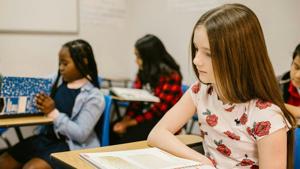
School choice improves learning at a lower cost, analysts say
As public education remains a concern for taxpayers, supporters of school choice programs argue that giving families more educational options can improve student outcomes at a lower cost.
More than 30 states have some form of school choice program, while 30 states have opted into the Trump administration’s Education Freedom Tax Credit Program, which will take effect Jan. 1, 2027.
Supporters of both state-level school choice programs and the federal tax credit say they give families more options to find schools that better fit their children’s educational needs.
Ryan Cantrell, chief state strategy officer at the American Federation for Children, told The Center Square that school choice programs put education dollars in the hands of parents and make them the decision makers.
“There really isn’t a better form of accountability than a parent being able to say, ‘This school is not working for my child. I am going to take those dollars and I’m gonna go elsewhere with them,’ ” Cantrell said.
As students’ public education continues to struggle academically, results from the National Assessment of Educational Progress show that student performance in reading and math have declined since 2019, with K-12 students as a whole at 30% proficiency.
Lance Izumi, senior director of education studies at Pasadena, Calif.-based Pacific Research Institute, said additional education spending does not necessarily translate into improved academic outcomes.
“It’s very difficult to look at these cries for more funding as anything more than just funding the adults in the system and not helping the students,” Izumi told The Center Square.
Izumi also said public schools are facing growing competition from charter schools, private schools and homeschooling options that participate in school choice programs.
According to Education World Wide, homeschooled students generally score between the 65th and 75th percentiles, while the average public school student scores near the 50th percentile.
A study by the National Home Education Research Institute found that homeschooled students typically score 15% to 25% higher on standardized academic achievement tests than public school students.
There are similar results for students who are in private and charter schools, outperforming students from public schools.
Private school students test higher than public school students. According to National Center for Education Statistics data, 88% of private high school students apply to college, compared to 57% of public high school students. Also, College Board reports indicate that SAT scores for private school students are around 1200 out of 1600, well above the national average of 1029, according to the Council for American Private Education.
For charter schools, academic results are generally similar to or slightly higher than those of traditional public schools. Yet a 2023 study by the Center for Research on Education Outcomes at Stanford University found that students attending charter schools made greater academic gains than their peers in traditional public schools because charter school students in mathematics advanced their learning by an additional six days over the course of a year.
In reading, they gained the equivalent of 16 additional days of learning, according to Stanford.
As charter schools aim to help low-income families, test scores from the California Assessment of Student Performance and Progress in English language arts show 49.7% of charter school students met or exceeded state standards. That’s compared to 49.2% of students in non-charter schools. In mathematics, 36.7% of charter school students met or exceeded standards, compared with 37.9% statewide in non-charter schools.
Meanwhile, the average cost of a school choice scholarship is roughly $6,000 per student, compared with about $18,000 in average public-school spending, according to EdChoice.
Cantrell highlighted research from Ohio that found positive outcomes for low-income students participating in voucher programs. According to a study by the Urban Institute, students who participated in school choice programs were more likely to enroll in college than students who remained in public schools and were also more likely to earn a bachelor’s degree.
“We are spending less money and getting better results,” Cantrell noted.
The Wisconsin Institute for Law & Liberty analyzed more than 100,000 low- and middle-income Wisconsin students between the 2018-19 and 2022-23 school years.
The review measured performance on the English Language Arts portion of the Wisconsin Forward Exam, a state assessment test for public school students and compared the results to school-choice students from similar economic backgrounds in the public school system.
“Researchers found that, across all three of Wisconsin’s major private-school choice programs, students who remained enrolled longer consistently experienced stronger academic growth in reading than similar students who stayed in public schools,” according to the Oklahoma Council of Public Affairs.
Jorge Elorza, CEO of Democrats for Education Reform and advocate for school choice, told The Center Square that Democrats have fallen behind both politically and policy-wise on K-12 education.
“Voters are watching. They see that we have been silent on this issue,” Elorza said. “Now there is a political imperative for us to reprioritize and refocus on K-12 education. And it can’t be more of the same. It can’t just be more money to be more of the same. That is not working.”





Sunny
