
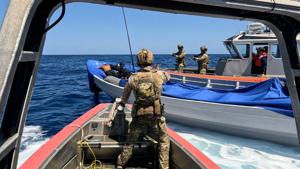
U.S. military, Coast Guard expanding technological capabilities
The U.S. military and U.S. Coast Guard are expanding their technological capabilities through a range of modernization initiatives, artificial intelligence and drones.
The Department of War said it is implementing a range of technological advancements in response to recommendations made in a White House Office of Science and Technology report, Science: A New Golden Age.
One advancement is partnering with the National Science Foundation to establish a framework to strengthen a shared research ecosystem, accelerate the transition of promising technologies and collaborate with government, academic, industry and other research partners. Initial areas of joint interest include X-Labs, the Programmable Cloud Laboratories Network, and a $40 million investment in AI Forge. Scientific advancement also involves using artificial intelligence, modernizing research infrastructure, building a new workforce, and developing emerging technologies, it says.
The DOW is dedicating $200 million to Programmable Cloud Labs in fiscal 2028 through its Future Years Defense Program, it says.
“Maintaining our technological edge requires balancing rapid innovation with responsible program protection,” Assistant Secretary of War for Science and Technology Joseph Jewell said. “As we accelerate how we move concepts from the lab to the field, we are equally committed to safeguarding federally funded research and ensuring domestic investments deliver tangible capabilities. By modernizing our testing facilities, empowering industry through initiatives like the Defense Patent Holiday, and expanding pathways for domestic scientific talent, we are safeguarding our nation’s economic vitality and national security, ensuring this new golden age drives lasting domestic strength and unrivaled technological capabilities for our warfighters.”
The DOW is also establishing a new enterprise-wide framework to measure and improve the performance and effectiveness of its in-house laboratories, Federally Funded Research and Development Centers and University-Affiliated Research Centers. The initiative will apply “metascience-informed principles to create measures of performance and measures of effectiveness” as metrics, it says. The goal is to improve how research organizations are assessed, governed and resourced.
A new DOW research center also has been launched, the Center for Defense Academic Research. The center is advancing two new initiatives, Problem-Based Basic Research Consortium and the Translational Research Initiative for Academia and Defense Partnership. The first “will unite multidisciplinary university research teams and world-class individual investigators to solve pressing scientific challenges, leveraging partnerships with nonprofit research foundations, selective international collaborations, and participation from industry and venture capital observers.” The second will pair transdisciplinary academic research teams with military service laboratories to develop solutions for military missions and readiness.
The DOW also awarded 750 scholars with a Science, Mathematics, and Research for Transformation scholarship and is exploring a talent exchange with the Department of Energy’s Genesis Mission Fellowship program.
The Coast Guard is expanding its technological capabilities using drones. It placed a $247.8 million order with General Atomics for four MQ-9B long-range unmanned aircraft systems, ground control stations and supporting equipment through a U.S. Customs and Border Protection contract.
The drones will give the Coast Guard greater ability to monitor offshore waters, protect U.S. borders and critical infrastructure, support search and rescue, combat drug trafficking, improve collecting and sharing intelligence, surveillance and reconnaissance missions, it says.
“The MQ-9B long-range unmanned aircraft systems will expand our reach and strengthen our ability to protect the nation,” Anthony Antognoli, assistant commandant and program executive officer for robotics and autonomous systems, said. “This investment will give Coast Guard crews a longer-range view of our maritime domain, helping them detect threats earlier, make better-informed decisions and act faster across our missions.”
The MQ-9B acquisition is funded through the historic $25 billion authorized by Congress through the “One Big Beautiful Bill,” the largest capital investment in Coast Guard history. Of the $25 billion, the Coast Guard ordered approximately $16.3 billion in new assets and capabilities, it says.
Among them is a $400 million contract awarded to modernize the Coast Guard’s training center complex in New Jersey and several billion to manufacture new Arctic cutters.
The announcement comes after the Coast Guard surpassed its recruiting goals for the third consecutive year.
Under the Trump administration, the Coast Guard now has its largest enlisted class in nearly four decades, The Center Square reported.






Sunny
